// Apo → Holo cross-validation
Find the drug pocket in the empty structure
We gave the pipeline only the ligand-free apo FMN riboswitch (PDB 6WJR) — no drug, no hints. From the empty structure it recovered half of the true FMN contact residues (9 of 18); the detected pocket centroid lands 2.7 Å from the FMN centroid in the holo co-crystal (PDB 3F2Q) — and 0.63 Å from the nearest ligand atom. The FMN riboswitch is a real antibacterial drug target — the same pocket Merck’s ribocil binds.
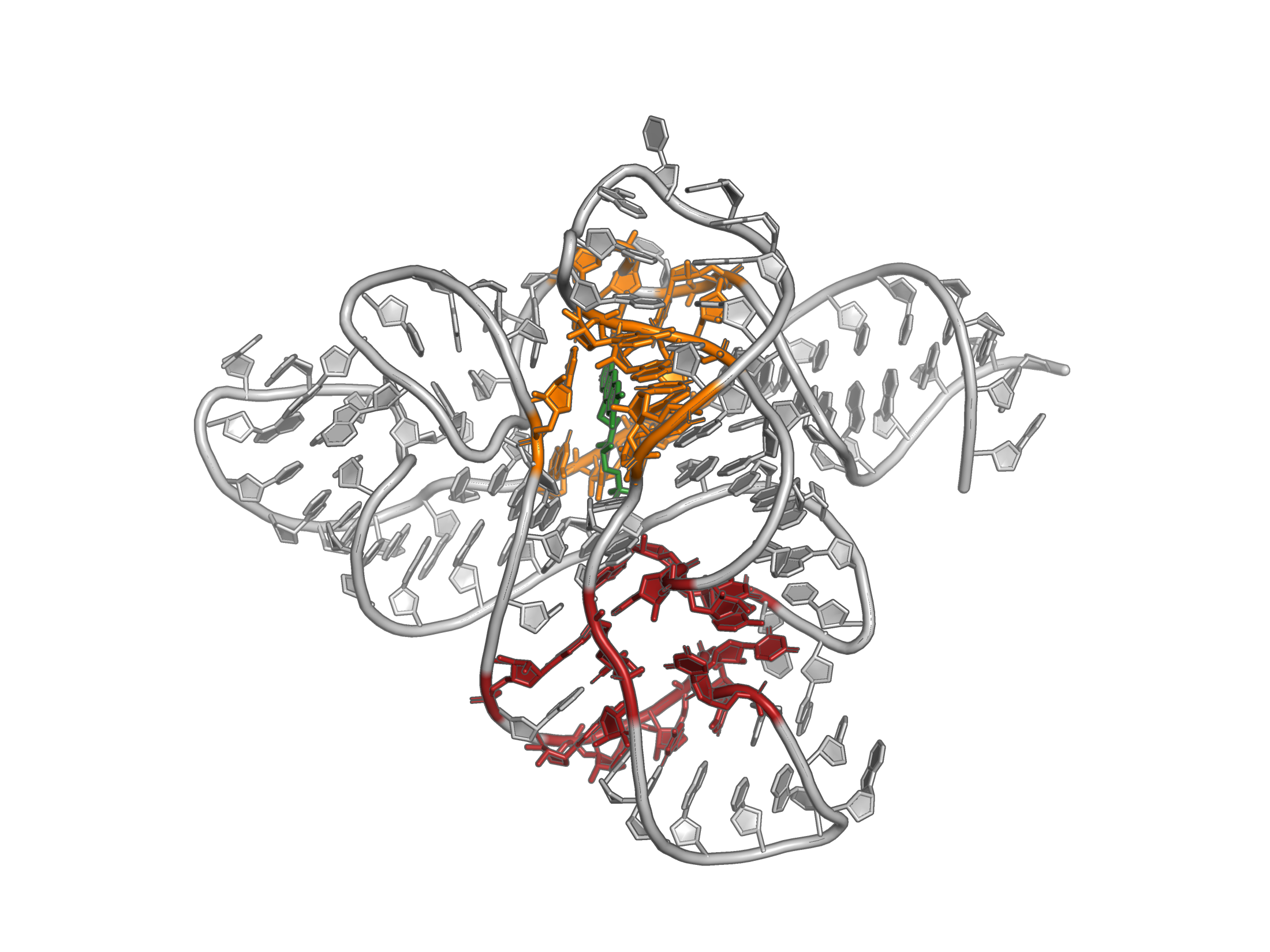
Cartoon backbone of the ligand-free apo structure (PDB 6WJR). Orange: the pocket we detected — it lands on the FMN site. Cyan: the real FMN drug, superposed in from the holo co-crystal (PDB 3F2Q). Red: the cavity off-the-shelf druggability scoring ranks #1 — ~12 Å from any drug. Legend shows each pocket’s cross-conformer persistence.
// Curated angle
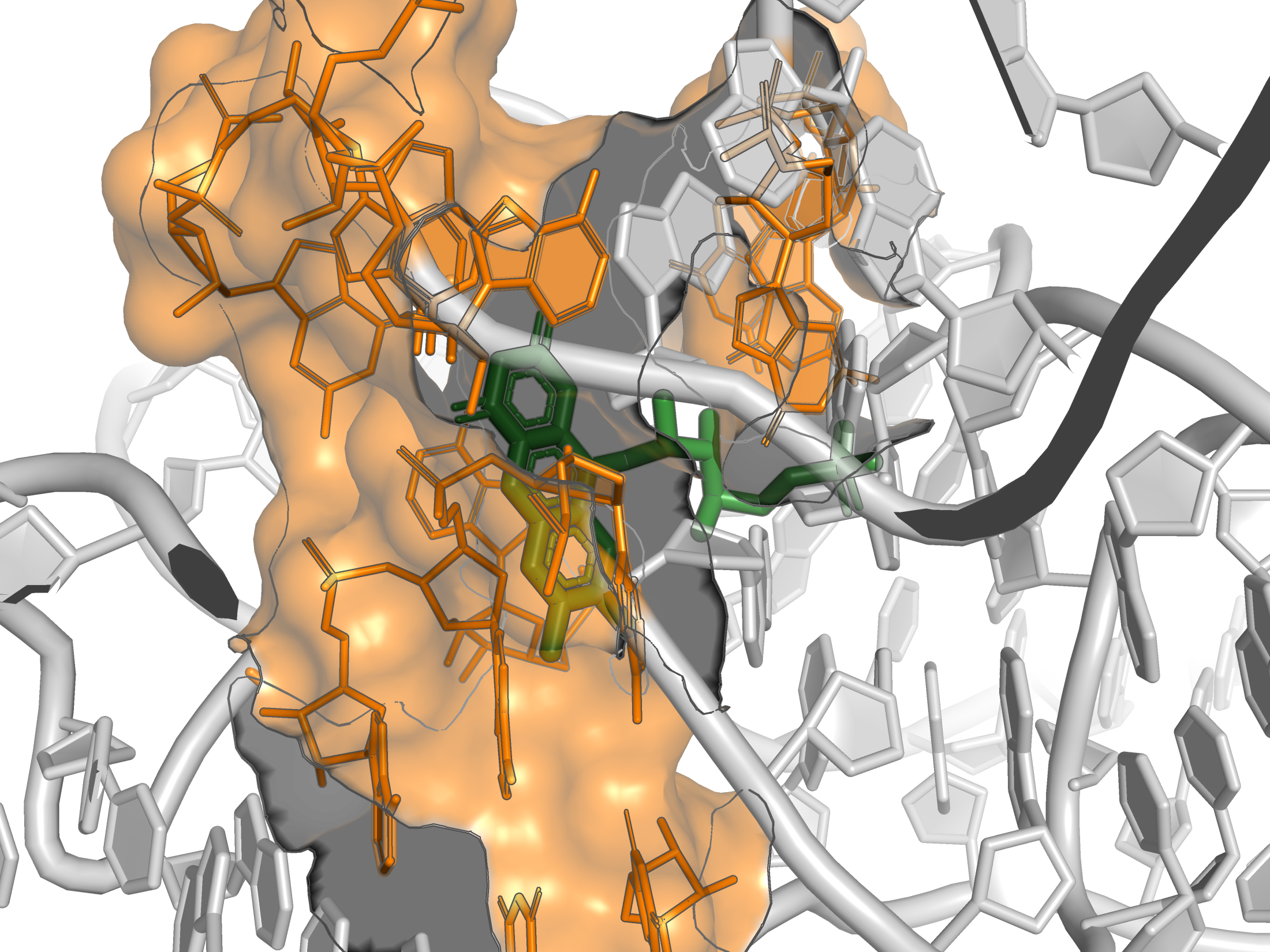
Orange: the pocket our pipeline detected from the apo structure alone. Green: the real FMN drug, superposed in from the holo co-crystal. It lands inside the detected pocket.
// Why off-the-shelf scoring fails on RNA
The standard druggability score points at the wrong cavity
fpocket’s druggability score is a protein-trained classifier. On this RNA it scores a decoy cavity at 0.75 — and the real FMN drug site at 0.01. Taken at face value it would send a discovery team ~12 Å away from any drug, to the wrong face of the molecule.
Our pipeline ignores that score by design and ranks on RNA-applicable geometry instead. The decoy and the true site are highlighted below — orange is the drug site, red is the high-“druggability” decoy.
// How to read this result
- This is a detection cross-validation, not a ranking benchmark. It measures how close our detected pocket lands to a known drug site when we start from the empty structure. The locked rank-1 benchmark lives on the methodology page.
- The drug pocket is detected, but it is not our top-ranked cavity here. Riboswitches are induced-fit — the pocket is only fully formed once the ligand is bound — so in the apo ensemble it is transient (present in 2 of 5 conformers). Our persistence ranker correctly reports it as sub-dominant. We do not present this as a rank-1 result.
- The structures. Apo input: PDB 6WJR. Holo ground truth: PDB 3F2Q. Both are the same 112-nt FMN riboswitch from Serganov, Huang & Patel, Nature 458:233 (2009).
// Reproduce / inspect
- apo_6wjr.pdb — the ligand-free input structure
- fmn_overlay.pdb — FMN drug, superposed into the apo frame
- pockets.json — every detected cluster, full per-cluster metadata
- summary.json — the numbers on this page
// More worked examples
Seven cleft-binder targets with locked strict@1 / near@1 recovery, including a second FMN riboswitch (5C45) as a benchmark cell.
All worked examples →