// Single-seq arm · near@1 · scope-honest
Global RMSD looks bad. The local pocket geometry recovers anyway.
On 5C45 the predicted structure’s C3′ backbone RMSD against the deposited co-crystal is 10.2 Å — by global-fold standards, poor. The rank-1 cluster nonetheless picks up 40% of the experimental FMN binding-site residues: above the 30% near@1threshold, below the 50% strict@1 threshold. The pre-pilot screen excludes MSA (min_id 0.808, no diverse-tail homologs); single-sequence is the as-shipped arm.
Why this case ships as a worked example rather than as a footnote: backbone RMSD is the wrong customer-facing quality metric on RNA. What matters is whether the cluster geometry overlaps the binding site. 5C45 is the canonical case where the two measures disagree, and we report both so the customer can see the gap.
Numbers from locked v0.2 benchmark · strict@K / near@K definitions
RNA pocket discovery
FMN riboswitch · 5C45
Bound by flavin mononucleotide (family ligand; 5C45 co-crystal binds the designed analog 51B) (PDB ligand FMN). 54 nt RNA target.
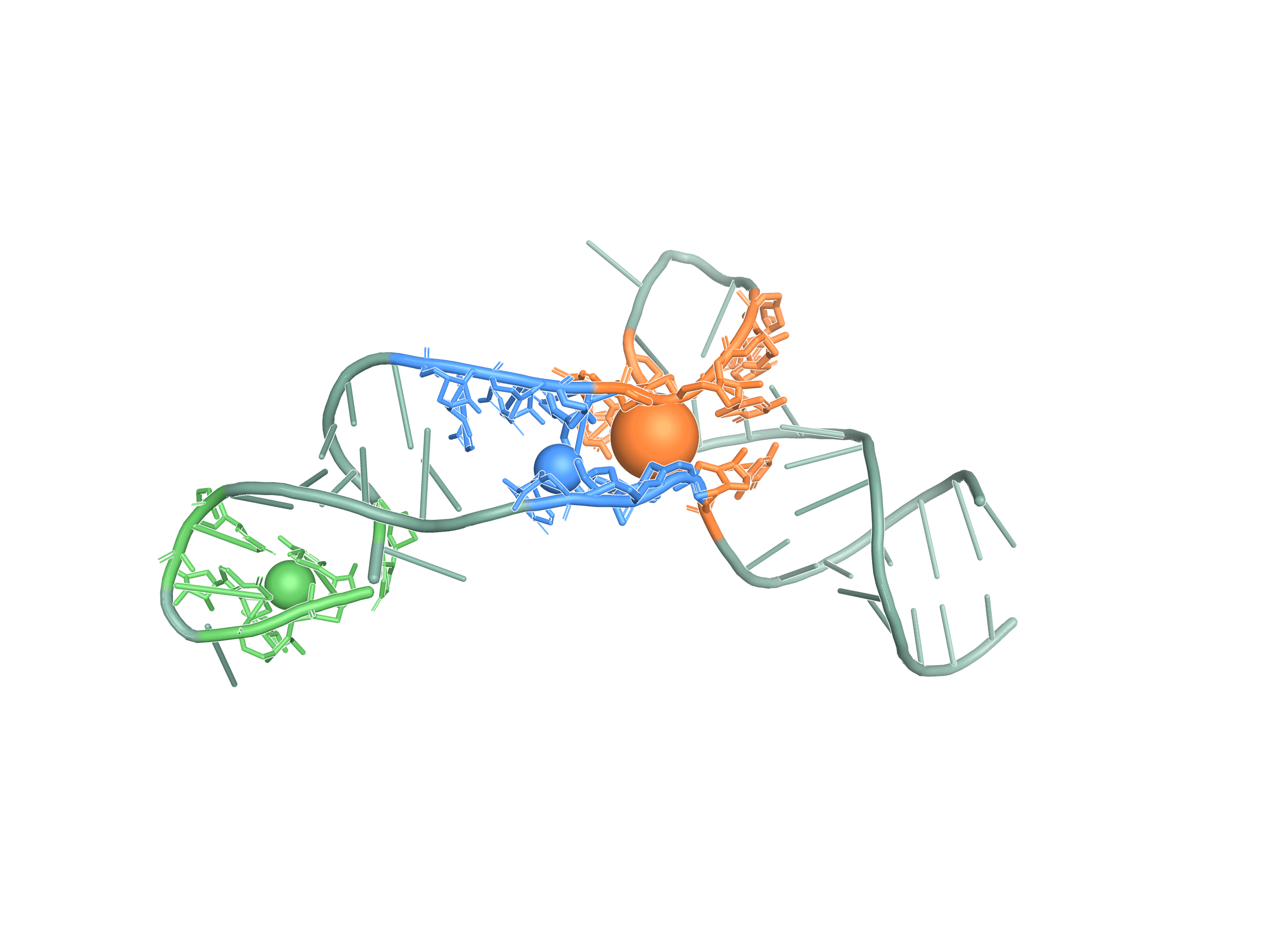
Top-3 candidate pockets
ranked by persistence × binding-residue stabilityCartoon backbone of the predicted reference frame. Top-3 pocket residues highlighted as licorice; centroid spheres mark each cluster's geometric centre across the ensemble. Hover a card to isolate that pocket. Toggle the experimental FMN overlay to see where the co-crystal ligand sits relative to the rank-1 cluster.
Sequence with pocket residues highlighted
Methods summary
v0.2 detects cavities on the predicted 3D structure using RNA-tuned fpocket parameters (consistent with the published fpocketR approach, Veenbaas et al. PNAS 2025), samples a 5-frame ANM conformational ensemble, and ranks pockets by structural persistence weighted by binding-residue stability (score = persistence × n_residues_intersected). The cross-frame geometric ranker is the load-bearing contribution: on a 7-target cleft-binder benchmark, RNA-tuned detection alone recovers 0 of 7 at strict@1; the ensemble + ranker lifts recovery to 3 of 7 strict@1 and 6 of 7 near@1. Druggability assessment itself is left to your medicinal-chemistry workflow; we provide the geometric metadata and conformational stability metrics as inputs to it. Computational predictions only — experimental validation is required before use in drug development.
// rank-1 binding-site overlap, this target
flat · already NEAR at single-frame detection
Binding-mode caveat
Pipeline detects cleft-shaped binding pockets. Groove-binding modes and shallow surface-deformation binding may be missed. Contact us if your target's binding mode is groove-mediated.
Computational predictions only. Experimental validation required before drug-development use.