// MSA path · pre-pilot screen passed
On 4LVV, the opt-in MSA path recovers what the single-sequence path misses.
Single-sequence prediction lands a rank-1 cluster at 19% binding-site overlap — neither strict nor near. The MSA-driven path on the same sequence lifts the rank-1 cluster to 50% overlap: strict@1. The pre-pilot tractability screen flags 4LVV for MSA mode on min_id 0.762 and a 11.5% diverse-tail fraction (criterion: min_id < 0.77 OR ≥ 5% homologs at 70–80% identity).
Same pipeline every worked example on this site runs. Bundle below: ensemble PDB, JSON pocket data, residues.csv and a branded PDF report.
Single-seq baseline from locked v0.2 benchmark · screen methodology
RNA pocket discovery
THF riboswitch · 4LVV
Bound by tetrahydrofolate (PDB ligand THF). 89 nt RNA target.
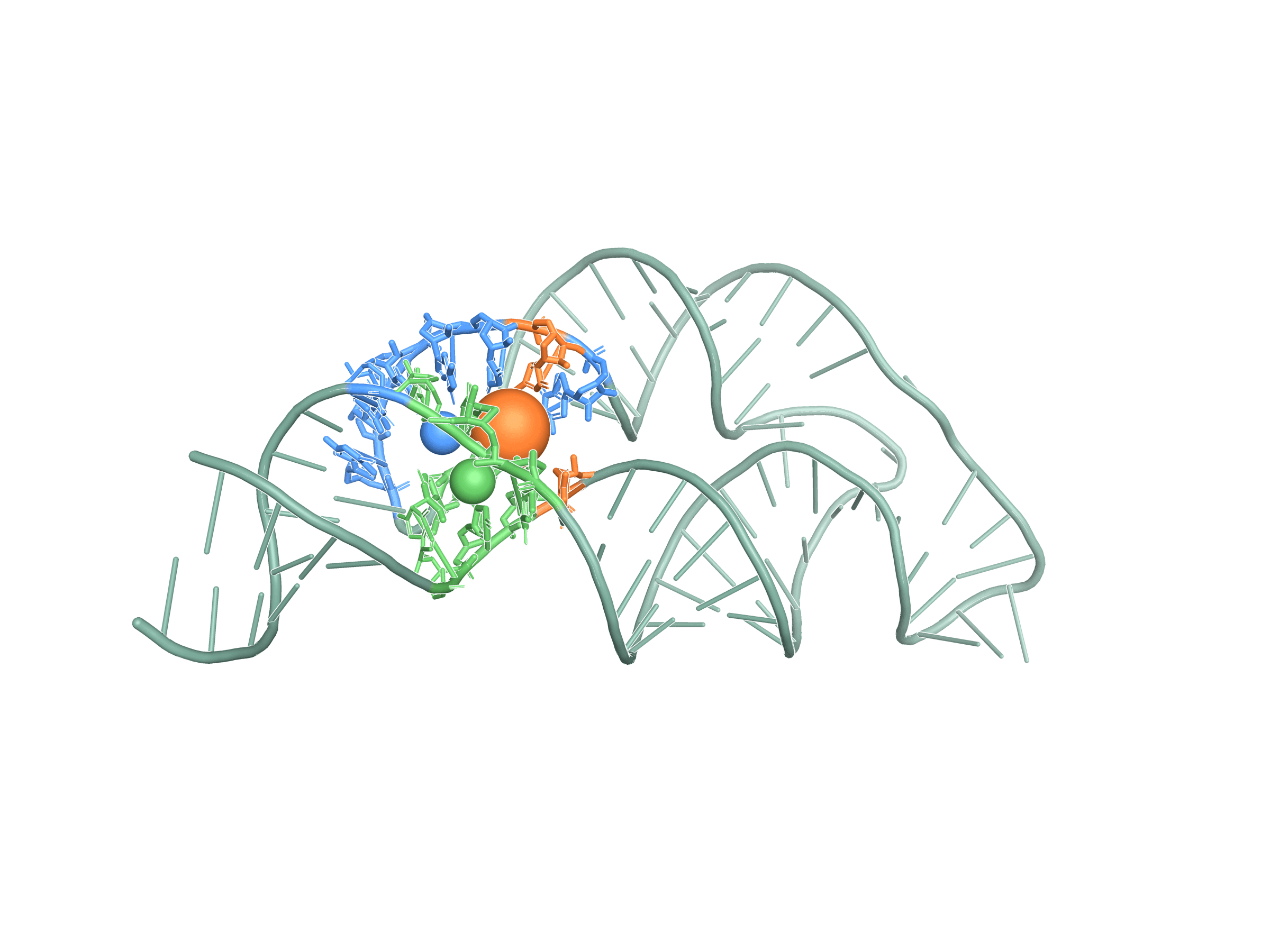
Top-3 candidate pockets
ranked by persistence × binding-residue stabilityCartoon backbone of the predicted reference frame. Top-3 pocket residues highlighted as licorice; centroid spheres mark each cluster's geometric centre across the ensemble. Hover a card to isolate that pocket. Toggle the experimental THF overlay to see where the co-crystal ligand sits relative to the rank-1 cluster.
Sequence with pocket residues highlighted
Methods summary
v0.2 detects cavities on the predicted 3D structure using RNA-tuned fpocket parameters (consistent with the published fpocketR approach, Veenbaas et al. PNAS 2025), samples a 5-frame ANM conformational ensemble, and ranks pockets by structural persistence weighted by binding-residue stability (score = persistence × n_residues_intersected). The cross-frame geometric ranker is the load-bearing contribution: on a 7-target cleft-binder benchmark, RNA-tuned detection alone recovers 0 of 7 at strict@1; the ensemble + ranker lifts recovery to 3 of 7 strict@1 and 6 of 7 near@1. Druggability assessment itself is left to your medicinal-chemistry workflow; we provide the geometric metadata and conformational stability metrics as inputs to it. Computational predictions only — experimental validation is required before use in drug development.
// rank-1 binding-site overlap, this target
+44 pp · NEITHER → STRICT
Binding-mode caveat
Pipeline detects cleft-shaped binding pockets. Groove-binding modes and shallow surface-deformation binding may be missed. Contact us if your target's binding mode is groove-mediated.
Computational predictions only. Experimental validation required before drug-development use.