// Single-seq arm · high RMSD · strict@1 anyway
Backbone RMSD 14 Å. Rank-1 cluster still strictly recovers the binding site.
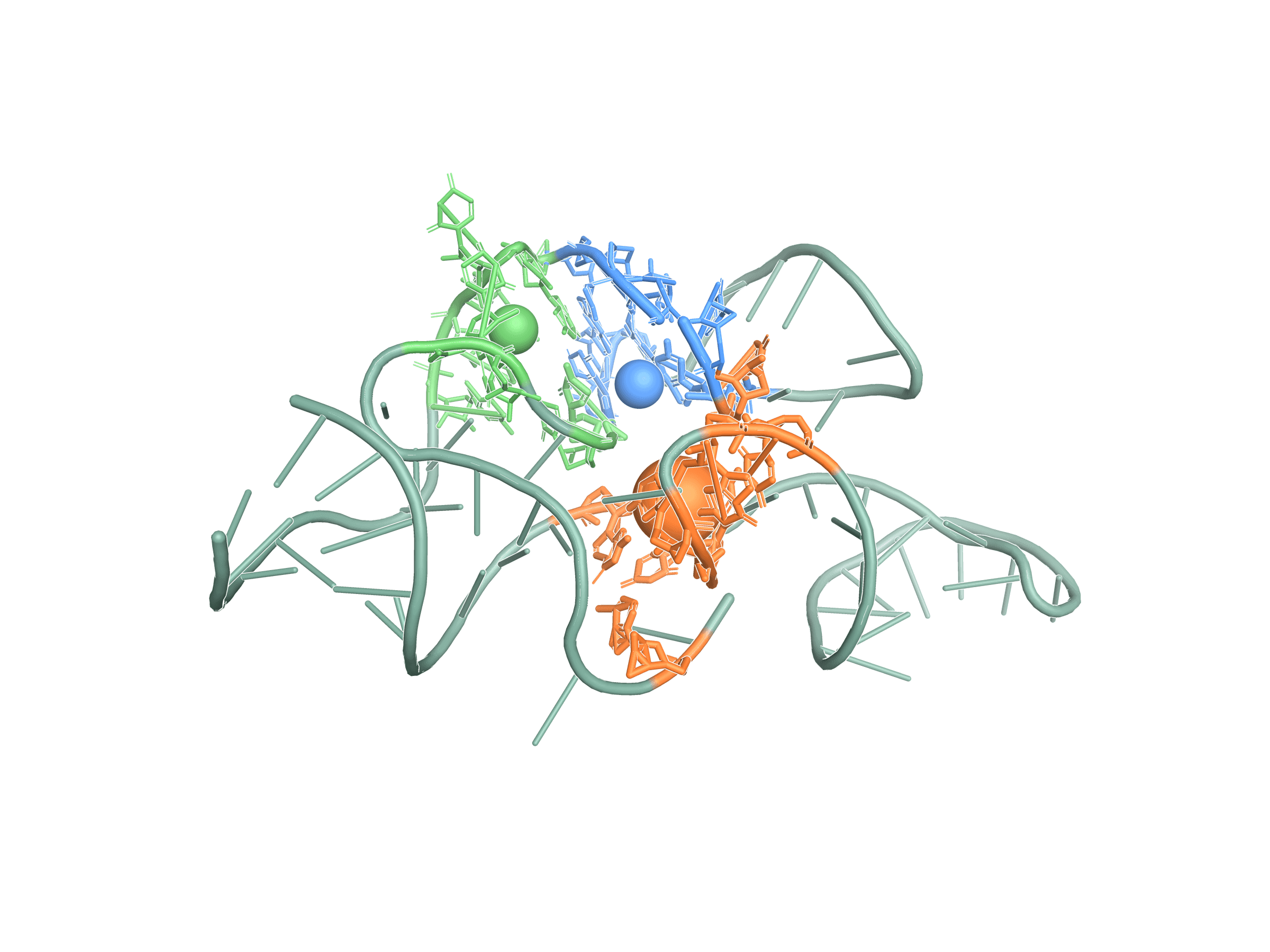
2HOJ is the inverse of 2GIS. The predicted backbone is the worst-fitting in the v0.2 benchmark — RMSD 13.95 Å against the deposited co-crystal — yet the rank-1 cluster lands at 53% binding-site overlap: STRICT@1. The TPP-binding pocket geometry is preserved within the prediction even as the global fold drifts away from native.
Read 2HOJ alongside 2GIS (near-perfect fold, only NEAR@1) and 5C45 (poor fold, NEAR@1 anyway). Together the three cases pin down what backbone RMSD does and does not tell you about whether the pipeline recovered a binding site: it is a useful diagnostic, not the quality metric. The metric that maps to customer usefulness is binding-site overlap.
Numbers from locked v0.2 benchmark · strict@K / near@K definitions
RNA pocket discovery
thi-box TPP riboswitch · 2HOJ
Bound by thiamine pyrophosphate (PDB ligand TPP). 83 nt RNA target.
Top-3 candidate pockets
ranked by persistence × binding-residue stabilityCartoon backbone of the predicted reference frame. Top-3 pocket residues highlighted as licorice; centroid spheres mark each cluster's geometric centre across the ensemble. Hover a card to isolate that pocket. Toggle the experimental TPP overlay to see where the co-crystal ligand sits relative to the rank-1 cluster.
Sequence with pocket residues highlighted
Methods summary
v0.2 detects cavities on the predicted 3D structure using RNA-tuned fpocket parameters (consistent with the published fpocketR approach, Veenbaas et al. PNAS 2025), samples a 5-frame ANM conformational ensemble, and ranks pockets by structural persistence weighted by binding-residue stability (score = persistence × n_residues_intersected). The cross-frame geometric ranker is the load-bearing contribution: on a 7-target cleft-binder benchmark, RNA-tuned detection alone recovers 0 of 7 at strict@1; the ensemble + ranker lifts recovery to 3 of 7 strict@1 and 6 of 7 near@1. Druggability assessment itself is left to your medicinal-chemistry workflow; we provide the geometric metadata and conformational stability metrics as inputs to it. Computational predictions only — experimental validation is required before use in drug development.
// rank-1 binding-site overlap, this target
+53 pp · NEITHER → STRICT
Binding-mode caveat
Pipeline detects cleft-shaped binding pockets. Groove-binding modes and shallow surface-deformation binding may be missed. Contact us if your target's binding mode is groove-mediated.
Computational predictions only. Experimental validation required before drug-development use.